Feature, Myanmar Times, 15/1/19.
In the 21st century it can be difficult to know where to pull your sartorial inspiration from. Our media diet can easily begin to feel overwhelming, heaped with brain-smoothing barrages of flash in the pan red-carpet looks, fresh colour palates that won’t last an entire season and ironic daggy-made-cool novelties that have the shelf life of a carton of milk. The maddening pace of ‘lifestyle’ online media has made it more difficult than ever to divine what is timelessly stylish from what is merely fashionable. On top of that, it can feel like we are endlessly trying to emulate one another. If we cast our minds back to the explosion of Ray-Bans earlier this decade, which took that cool, artsy mid-century look and re-branded it to the degree that it became the default eyewear for a generation of hip young people, we can begin to see how striking out as an individual has become more difficult to do. There are ways to become your own work of art, however. Having an eye for design and your personal tastes helps. Having a tailor is even better.
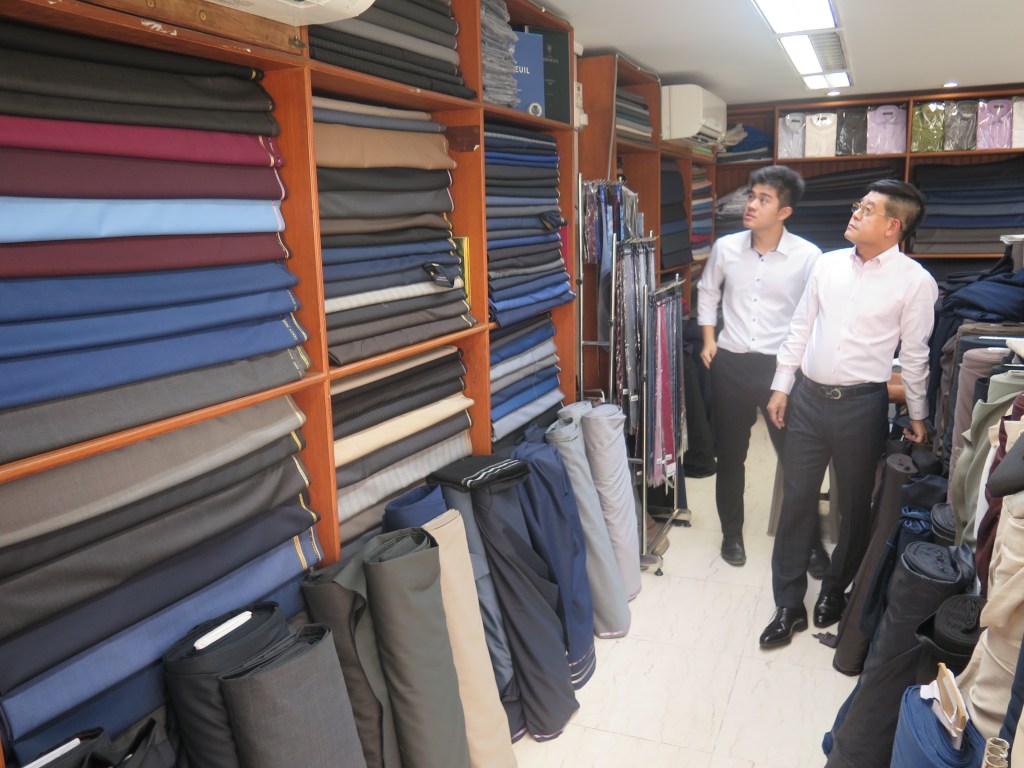
When Thet Lwin, current master cutter and owner of Sein Shwe Tailors, began his apprenticeship in the family business, he was just 16 years old. His father, Sein Shwe, was an experienced tailor and cutter. He taught Thet Lwin everything there was to know about handling customer accounts and providing personal services, making sure the shop could rely on repeat business and good reputation, as well as the measuring, cutting and construction of many varieties of cloth, the constitution of each dictating how it should be treated and worn to best effect. Part of the branding, of course, is making sure the clothes your clients are parading around in not only fits well, but can show of the craftsmanship of the cutter. Indeed, it can lead many tailors to stick to more conservative tried-and-true styles. It’s like a negotiation process with the customer, who, invariably, is always right, even when they’re not. ‘Guidance’ in these matters takes a deft touch. Thet Lwin, who opened his own store in the 1990s and named it in honour of his father, is that shepard to his customers. He is in the process of preparing his own twenty-two year old son to one day receive the torch and carry on the family profession with a similar seriousness.
As far as learning those ropes are concerned, the services Sein Shwe offer are ostensibly straight-forward; made-to-measure business and formal attire catering mostly to business men and woman, for wedding parties and the occasional pair of trousers or constructed shirt for a blow-in who, if things go to plan, might become a patron.
The process begins with the inspection of cloth and deciding on the most suitable pattern. If you’re in a business such as sales or administration, perhaps you will choose to play it safe with a block charcoal or lightly patterned navy blue – but then maybe you move in different circles and like a little more pop to your your appearance (seasonal dressing is also a concern). You might then opt for a Prince of Wales check or a bold chalkstripe on beige or even pink. Less confident shoppers might place all their faith in the tailor to guide them through the process, but doing one’s own internet research and examining, say, the outfits of certain celebrities beforehand can be a great help in explaining to the tailor the sort of look you are seeking to achieve. Once the cloth is chosen, the customer will outline the style or context of the outfit, decide how many pockets they will require, the number of buttons on the jacket and other small details that will draw the ensemble together. The next stage is the measuring – a brief process in which the customer is required to awkwardly stand in a t-pose as measuring tape is run over their body and their dimensions are called out to a second (sometimes an occasion to blush).
Measurements taken, you can confirm your details, place down a deposit and exit the shop with that slight flutter of excitement for the next stage, which is the fitting. The fitting stage is a half-way adjustment, in which the loosely, or rather, half-way constructed, garment will be tested for fit and to make sure the customer wants to commit to their stylistic decisions. With the final okay, or some quick adjustment lines made in chalk, there is only the final construction process before, usually two to four weeks later, a fully sewn jacket and trousers will emerge. At that point, the customer is requested to undergo a final fitting to ascertain their satisfaction and presented with their new items in a crisp hanging bag. They can walk away satisfied that undoubtedly, unlike most anyone else on the street, they know the name of the person who made their clothes. A standard single jacket-and-trousers suit from Sein Shwe costs between $250 and $500 USD, depending on material, and takes around one month to be completed.
“Royal blue is very popular now”, Thet Lwin, a man of relatively few words, said, as he showed off his work station. He typically outfits himself with crisp white business shirt, dark trousers and black oxfords. He makes his own clothes and prefers a fitted look. Though the work is painstaking, it is undoubtedly a creative outlet. Thet Lwin said of his vocation, “It’s both business and pleasure for me. I’ve been doing it so long, it just feels natural”. He showed off his work station where the cuttings are made.
“This drawing measurement device is as old as I am. You can’t buy these things new in Myanmar” – he said with a wry smile.
The shop has served a great many people in its long tenure, including the former British ambassador, who has a penchant for plain navy blue cotton. There are also a number of Myanmar celebrities in their Rolodex, who opt for more flamboyant, or flashy, numbers to show off at major industry events. “My father made suits for film actors like Win Oo and Nay Aung”, Thet Lwin said (stars of the 1960s and 70s). “I’m not sure if people now remember them”. While any good tailor gains business through word of mouth (Where did you get that?), the contemporary market is all about social media visability and having your better known clients out making a great impression for the cameras.
Business is reportedly humming along, with the family drawing most if its assets from the inherited skills of its line of master cutters. It is now up to the recently returned son Thi Han Minn to learn how the machine operates, as it were, and gain the needed finesse in retailing couture clothing. A family first, he is completely fluent in English and foreign educated, and so is reasonably expected to bring a new savviness and youthful, internationalist energy to what essentially remains an old family institution. Even with a wealth of experiences new to to the family, he has definitely inherited his father’s thrift with words. “It’s alright by me”, he responded stoically. It never seemed in doubt that he was to be the next master cutter.
 The Alcatraz Review